
The Silent Epidemic Meets Modern Science: A Deep Dive into TB Diagnostics, PCR, CBNAAT, and Kashmir’s Fight for a TB-Free Future
For generations, a persistent, rattling cough was one of the most terrifying sounds a family could hear. Tuberculosis, historically known as “consumption,” has stalked humanity for millennia, leaving a devastating toll in its wake. Even today, it remains one of the world’s most formidable infectious diseases. But if you look closely at the landscape of modern medicine, you’ll notice a massive shift. The narrative is no longer just about managing the disease; it is about outright eliminating it.
This dramatic shift isn’t just due to better medications. The real heroes of this medical revolution are the quiet, sophisticated machines humming away in molecular biology laboratories. We have moved from an era of agonizingly slow diagnosis to one of rapid, DNA-level precision.
If you or a loved one has been advised to undergo an MTB PCR or a CBNAAT test, you likely have a lot of questions. What do these acronyms mean? Why isn’t a simple X-ray enough? And how do these tests fit into the larger picture of eradicating TB in regions like Jammu and Kashmir?
Let’s break down the science, the testing methods, and the incredible public health triumphs happening right in our own backyards.
The Anatomy of an Ancient Foe: Understanding Mycobacterium tuberculosis
To understand why we need such complex tests, we first need to understand the enemy. Tuberculosis is caused by a remarkably stubborn bacterium called Mycobacterium tuberculosis.
Unlike common bacteria that cause strep throat or standard pneumonias, the TB bacterium has a thick, waxy cell wall rich in mycolic acids. This biological armor makes it incredibly hardy. It can survive in dry states for weeks, it resists standard disinfectants, and most importantly, it evades the human immune system with terrifying efficiency. When inhaled, these bacteria travel deep into the lungs. In response, our immune system sends white blood cells to attack. But instead of being destroyed, the TB bacteria allow themselves to be swallowed by the immune cells, essentially using them as a Trojan Horse to multiply.
The Two Faces of the Disease
When people hear “TB,” they immediately think of the lungs. This is Pulmonary Tuberculosis, which accounts for the vast majority of cases. It is highly contagious, spreading through the air when an infected person coughs, sneezes, or even speaks.
However, the bacteria are master escape artists. In a significant number of cases, the bacteria breach the lung tissue, enter the bloodstream or lymphatic system, and set up camp elsewhere. This is known as Extrapulmonary Tuberculosis. It can attack the spine (Pott’s disease), the brain and spinal cord (TB meningitis), the kidneys, the lymph nodes, and the lining of the lungs (pleural TB).
Extrapulmonary TB is notoriously difficult to diagnose because the bacteria are sequestered deep within the body, making them incredibly hard to capture in a standard test.
The Old Guard: Why Traditional Diagnostics Are No Longer Enough
For a very long time, doctors relied on a diagnostic toolkit that, while groundbreaking in its time, is fundamentally flawed by today’s standards.
Sputum Smear Microscopy
If you had a cough in the 1990s, the doctor would ask you to spit into a cup. A lab technician would take that sputum, smear it on a glass slide, dye it with a special chemical, and look through a microscope for tiny, pink, rod-shaped bacteria (Acid-Fast Bacilli, or AFB).
While cost-effective and easy to perform, the smear test has a glaring weakness: its sensitivity is incredibly low. For a lab technician to actually see the bacteria on that slide, the patient’s sputum must contain roughly 10,000 bacteria per milliliter. If a patient is in the early stages of the disease, or if they have Extrapulmonary TB, their bacterial load might be much lower. The slide looks clean, the test comes back negative, and the patient goes home, undiagnosed and potentially still contagious.
The Waiting Game: Bacterial Culture
The gold standard for decades was the bacterial culture. The lab takes the patient’s sample and places it in a nutrient-rich environment, waiting for the bacteria to grow. Because Mycobacterium tuberculosis grows exceptionally slowly, it can take anywhere from two to six weeks to get a positive result.
Imagine telling a highly infectious, coughing patient—or a patient with aggressive spinal TB—that they need to wait a month and a half to know for sure what’s making them sick. In the world of infectious diseases, time is life. We needed a better way.
The Molecular Revolution: How MTB PCR Changed Everything
This brings us to the modern era of diagnostics, heavily reliant on a Nobel Prize-winning technology: the Polymerase Chain Reaction, or PCR.
You might be familiar with PCR from the COVID-19 pandemic, but its application in diagnosing Tuberculosis has been quietly saving lives for years. The MTB PCR (Mycobacterium tuberculosis Polymerase Chain Reaction) test doesn’t look for the whole bacterium, and it doesn’t wait for it to grow. Instead, it looks for the unique genetic fingerprint—the DNA—of the TB bacteria.
The Photocopier Analogy
Think of the patient’s sample as a massive library with millions of books (human DNA, normal mouth bacteria, respiratory cells). The TB bacteria is a single sentence hidden inside one specific book. Finding it with a microscope is nearly impossible.
PCR works like a targeted, chemical photocopier. It uses specialized enzymes that are programmed to seek out only the specific DNA sequence of the TB bacteria. Once it finds that sequence, it copies it. Then it copies the copies. Within a few hours, that single microscopic strand of TB DNA is amplified millions of times until it becomes a massive, undeniable signal that the lab equipment can easily detect.
Because of this amplification, the MTB PCR test is breathtakingly sensitive. It can detect the presence of the disease even if there are only a handful of bacteria in the entire sample.
A Lifesaver for Extrapulmonary TB
This extreme sensitivity makes MTB PCR an absolute lifesaver for patients with Extrapulmonary TB. When a doctor extracts fluid from the spine, or performs a biopsy on a swollen lymph node, the amount of bacteria present is usually tiny. A traditional smear will almost always fail to find it. MTB PCR, however, will amplify those few strands of DNA, providing a definitive diagnosis in 24 to 48 hours instead of weeks.
CBNAAT (GeneXpert): The Automated Wonder
As powerful as PCR is, scientists wanted to make it faster, safer, and more automated. Enter the Cartridge Based Nucleic Acid Amplification Test (CBNAAT), widely known by its brand name, GeneXpert.
CBNAAT takes the brilliant science of PCR and puts it into a self-contained, automated box. A patient’s sample is mixed with a reagent and poured into a plastic cartridge. That cartridge is slotted into the CBNAAT machine. From there, human hands are no longer needed. The machine automatically purifies the sample, extracts the DNA, and runs the amplification process.
But CBNAAT has one specific superpower that makes it the vanguard of modern TB treatment: it simultaneously tests for drug resistance.
The Threat of MDR-TB and the Rifampicin Solution
Tuberculosis is treated with a strict regimen of heavy antibiotics taken over six to nine months. The most powerful drug in this cocktail is Rifampicin. However, because patients often stop taking their medication once they feel better—long before the bacteria are actually wiped out—the surviving bacteria mutate. They learn how to fight back.
This leads to Multi-Drug-Resistant TB (MDR-TB), a terrifying variant of the disease that ignores standard medications. Treating MDR-TB requires toxic, expensive, and difficult second-line drugs for up to two years.
Before CBNAAT, finding out if a patient had MDR-TB required a culture test that took weeks. During those weeks, the patient was given standard drugs that didn’t work, all while spreading the resistant strain to their family and community.
CBNAAT changed the rules of the game. Within exactly two hours, the machine tells the doctor two things:
Yes, the patient has Tuberculosis.
Yes or No, the bacteria’s DNA contains the specific mutation that makes it resistant to Rifampicin.
This means a doctor knows on day one exactly which drugs will work and which won’t. It is precision medicine at its finest.
Getting the Sample Right: The Unsung Hero of Diagnostics
All of this incredible technology is useless if the initial sample collected from the patient is poor. The phrase “garbage in, garbage out” is a fundamental law of laboratory science. Ensuring you provide the right sample is a critical part of the diagnostic journey.
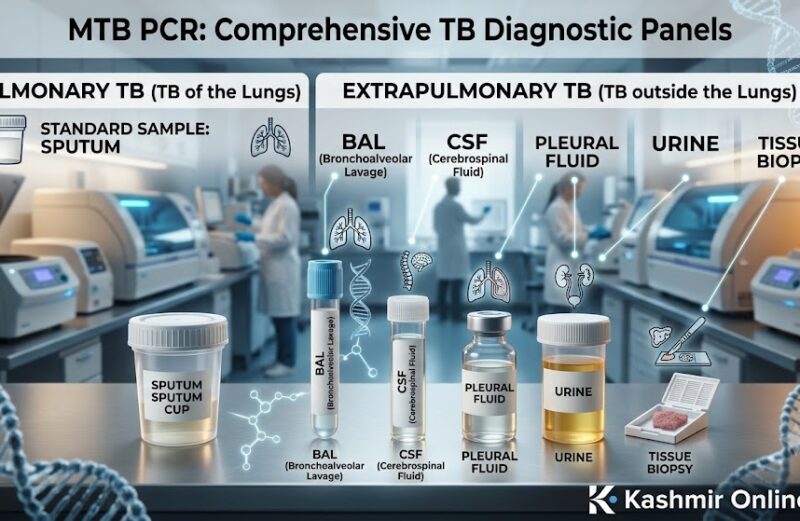
Sputum Collection (For Pulmonary TB)
When a doctor asks for a sputum sample, they are not asking for saliva. Saliva comes from the mouth and contains almost no diagnostic value for a lung infection. True sputum is the thick, often discolored mucus coughed up from deep within the respiratory tract. To get a good sample, patients are advised to rinse their mouth with water (to clear food and normal bacteria), take a deep breath, and produce a deep chest cough. Early morning samples are usually the best, as mucus pools in the lungs overnight.
Beyond Sputum: Sampling for Extrapulmonary TB
If the TB is hiding outside the lungs, specialized medical procedures are required to get the sample to the molecular lab.
BAL (Bronchoalveolar Lavage): If a patient cannot produce sputum, a pulmonologist may insert a thin tube down the airway to wash the lungs with sterile saline and collect the fluid.
CSF (Cerebrospinal Fluid): For suspected TB meningitis, a doctor performs a lumbar puncture (spinal tap) to collect the fluid surrounding the brain and spinal cord.
Pleural Fluid: If TB attacks the lining of the lungs, fluid builds up in the chest cavity, causing immense pain. A needle is used to drain and collect this fluid for PCR testing.
Tissue Biopsies: Sometimes, the only way to catch the bacteria is to take a small surgical sample of the infected tissue, such as a lymph node.
The Pradhan Mantri TB Mukt Bharat Abhiyaan: A Grassroots Revolution
Technology alone cannot solve a public health crisis. It requires infrastructure, political will, and community engagement. In India, the fight against Tuberculosis has been supercharged by the Pradhan Mantri TB Mukt Bharat Abhiyaan (PMTBMBA).
The national goal is staggeringly ambitious: entirely eliminate TB from India by 2025, beating the global sustainable development target by a full five years.
This Abhiyaan recognizes that TB is a social disease as much as a medical one. It thrives in overcrowded spaces and preys on the undernourished. The campaign doesn’t just focus on supplying CBNAAT machines; it focuses on active case finding. Mobile testing vans navigate difficult terrains to reach tribal and rural populations. Nutritional support programs, such as the Ni-kshay Poshan Yojana, ensure that patients have the dietary strength to endure the heavy antibiotic regimens. It is a holistic, aggressively executed strategy aimed at finding every single case, testing it rapidly, and treating it completely.
Kashmir’s Triumph: Charting the Green Zones
Nowhere is the success of this aggressive strategy more apparent than in Jammu and Kashmir. The region has historically faced unique challenges in healthcare delivery due to its rugged geography and harsh winters. Yet, the local administration, combined with the tireless efforts of healthcare workers and advanced diagnostic labs, has turned the tide.
Under the stringent sub-national certification criteria—which rigorously evaluates a region based on its reduction of TB cases compared to a baseline year—Kashmir has achieved milestones that seemed impossible a decade ago.
The TB-Free Districts: In a historic healthcare victory, the districts of Budgam, Anantnag, and Pulwama have been officially declared TB-free. This signifies an extraordinary 80% reduction in cases. It means the chain of transmission has effectively been broken in these communities.
The Gold Standard: The capital city of Srinagar, alongside the border district of Kupwara, have been awarded Gold certification, representing a massive 60% drop in their disease burden.
Because of these localized, hard-fought victories, the entire Union Territory of Jammu and Kashmir has been awarded a Bronze medal on the national stage. This isn’t just a statistical victory; it represents thousands of families spared from grief, financial ruin, and chronic illness.
The Road Ahead: What Patients Need to Know
While the successes in Kashmir are monumental, health officials and diagnostic experts know that the final stretch of any eradication campaign is the hardest. The bacteria are still out there, and staying vigilant is non-negotiable.
If you have a persistent cough, unexplained weight loss, chronic low-grade evening fevers, or severe night sweats, you must not ignore it. The stigma surrounding TB is a relic of the past; today, it is a highly curable disease, provided it is caught early and accurately.
When navigating your health, the laboratory you choose for your diagnostics acts as the compass for your doctor’s treatment plan. Advanced molecular tests like MTB PCR and CBNAAT require pristine, contamination-free environments, highly calibrated machines, and expert technicians. A compromised sample or an improperly run PCR test can lead to a false negative, allowing the disease to progress silently.
Choose a diagnostic center that utilizes NABL-compliant protocols and offers stress-free, hygienic home collection services. Modern medicine has ensured that you no longer have to wait weeks in fear to understand what is happening inside your body. The truth is now available in a matter of hours, hidden right there in the DNA, waiting to be amplified.