Revolutionizing Tuberculosis Diagnosis: The Power of CBNAAT and J&K’s Triumph in the TB Mukt Bharat Abhiyaan
Tuberculosis (TB) has been one of humanity’s most persistent and devastating health adversaries for centuries. Caused by the Mycobacterium tuberculosis bacteria, this infectious disease primarily attacks the lungs but can spread to other parts of the body. For decades, the fight against TB was hindered by slow diagnostic tools, prolonged treatment regimens, and the heavy social stigma attached to the illness.
However, the landscape of TB management is undergoing a dramatic transformation. With the advent of rapid molecular diagnostics like the Cartridge Based Nucleic Acid Amplification Test (CBNAAT) and aggressive national health initiatives, the goal of a TB-free society is rapidly becoming a reality. In India, this charge is led by the Pradhan Mantri TB Mukt Bharat Abhiyaan (PMTBMBA), an ambitious initiative aimed at eliminating the disease nationwide by 2025, a full five years ahead of the global 2030 target.
This blog post explores the critical diagnostic tools spearheading this medical revolution and celebrates the remarkable, historic milestones achieved in Jammu & Kashmir under this national campaign.
The Diagnostic Arsenal: How We Detect Tuberculosis
Accurate and rapid diagnosis is the cornerstone of effective TB treatment and containment. Historically, diagnosing TB was a waiting game, often relying on tests that took weeks to yield results. Today, modern science provides a robust toolkit for healthcare professionals.
The Game Changer: CBNAAT (GeneXpert)
The Cartridge Based Nucleic Acid Amplification Test (CBNAAT) is widely considered a revolutionary breakthrough in infectious disease diagnostics. But what makes it so special?
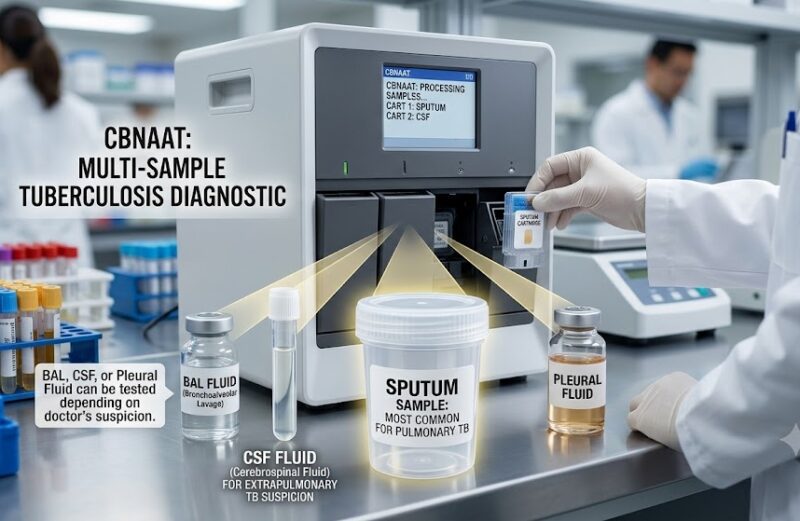
Unlike traditional methods that rely on identifying the bacteria under a microscope or growing it in a laboratory culture, CBNAAT is a molecular test. It works by detecting the specific DNA of the Mycobacterium tuberculosis complex directly from a patient’s sample (most commonly sputum, but also cerebrospinal fluid, pleural fluid, or lymph node aspirates).
Key Advantages of CBNAAT:
Unprecedented Speed: While traditional culture tests can take up to six weeks to return a definitive result, CBNAAT provides highly accurate results in just about two hours.
Simultaneous Resistance Testing: The most critical feature of CBNAAT is its ability to simultaneously check if the TB bacteria strain is resistant to Rifampicin, which is one of the most powerful and common first-line anti-TB drugs.
Early Intervention: By immediately identifying Multi-Drug-Resistant TB (MDR-TB), doctors can place patients on the correct, targeted antibiotic regimen from day one, drastically improving survival rates and preventing the spread of resistant strains.
High Sensitivity: It is incredibly sensitive and can detect TB in patients with very low bacterial loads, which traditional smear microscopy often misses.
Comprehensive TB Testing Methods
While CBNAAT is the gold standard for rapid diagnosis, it is part of a broader diagnostic ecosystem. Depending on the patient’s symptoms and medical history, doctors may utilize a combination of the following tests:
| Test Name | Mechanism | Primary Use Case & Speed |
| Sputum Smear Microscopy | Examining a stained sputum sample under a microscope to look for bacteria. | A traditional, cost-effective initial screening tool. Results are available within a day, but it has lower sensitivity than molecular tests. |
| Bacterial Culture | Growing the bacteria from a patient sample in a controlled laboratory environment. | Highly accurate and used to test for resistance to a wider array of drugs. However, it is slow, taking 2 to 6 weeks for results. |
| Chest X-Ray | Imaging the lungs to look for characteristic abnormalities, cavities, or fluid build-up. | Used to assess the extent of lung damage and as a supportive diagnostic tool alongside sputum tests. Immediate results. |
| IGRA Blood Test | Measures the immune system’s reactivity to TB bacteria in the blood. | Used to diagnose “Latent TB” (when the bacteria is in the body but not active or contagious). Results in 24-48 hours. |
| Mantoux (Skin Test) | Injecting a small amount of tuberculin protein under the skin and measuring the reaction. | Another tool for identifying Latent TB, often used for mass screening in high-risk populations. Read after 48-72 hours. |
TB Mukt Bharat Abhiyaan: A National Movement
Launched to accelerate the eradication of Tuberculosis, the Pradhan Mantri TB Mukt Bharat Abhiyaan (PMTBMBA) represents a holistic, aggressive approach to public health. The initiative recognizes that TB is not merely a medical issue but a profound social and economic burden that disproportionately affects vulnerable, malnourished, and marginalized communities.
The Abhiyaan focuses on active case finding, ensuring equitable access to high-quality diagnostics like CBNAAT, and providing nutritional support to patients. It operates on the philosophy that eliminating TB requires a “people’s movement” rather than just a government mandate. This involves grassroots awareness campaigns, deploying mobile testing units (like the newly flagged off Ni-kshay Vahans in Srinagar and Baramulla) to reach remote areas, and destigmatizing the illness so patients seek timely help.
A Ray of Hope: The Historic Success in Jammu & Kashmir
The relentless efforts of healthcare workers, local administration, and the community under the TB Mukt Bharat Abhiyaan have yielded phenomenal results in the Union Territory of Jammu & Kashmir. The region has become a shining example of what dedicated public health initiatives can achieve.
Under the National Tuberculosis Elimination Program’s sub-national certification criteria, regions are rigorously evaluated and awarded based on their reduction of TB cases compared to a baseline year.
Bronze Medal: Over 20% reduction
Silver Medal: Over 40% reduction
Gold Medal: Over 60% reduction
TB-Free Status: An extraordinary 80% reduction in cases
Celebrating the TB-Free Districts
In a monumental healthcare victory, three districts in Kashmir—Budgam, Anantnag, and Pulwama—have been officially declared TB-free. This means these districts have successfully achieved an 80% reduction in their TB caseload, successfully breaking the chain of transmission and creating a healthier environment for their citizens.
The success does not stop there. The capital city of Srinagar, alongside the Kupwara district, have been awarded the prestigious Gold certification, signifying a massive reduction in the disease burden.
Collectively, these localized victories have propelled the entire Union Territory forward. Recognizing these immense strides in combating the disease, Jammu and Kashmir as a whole has earned a Bronze medal in the National Fight Against Tuberculosis.
The Road Ahead: Eradication and Vigilance
While the declaration of TB-free districts in J&K is a cause for massive celebration, health officials have made it clear that the fight is far from over. With a 100-day intensified campaign recently launched, the focus is now shifting from elimination to total eradication.
Challenges such as social stigma, delayed diagnoses, and treatment dropouts remain hurdles that require constant vigilance. The deployment of mobile care units targeting high-risk populations—including diabetics, smokers, and tribal communities—ensures that the momentum is sustained.
The success story of J&K proves that with the right combination of advanced diagnostic tools like CBNAAT, unwavering government support, and active community participation, a TB-Free India is not just an ambitious dream—it is a rapidly approaching reality.