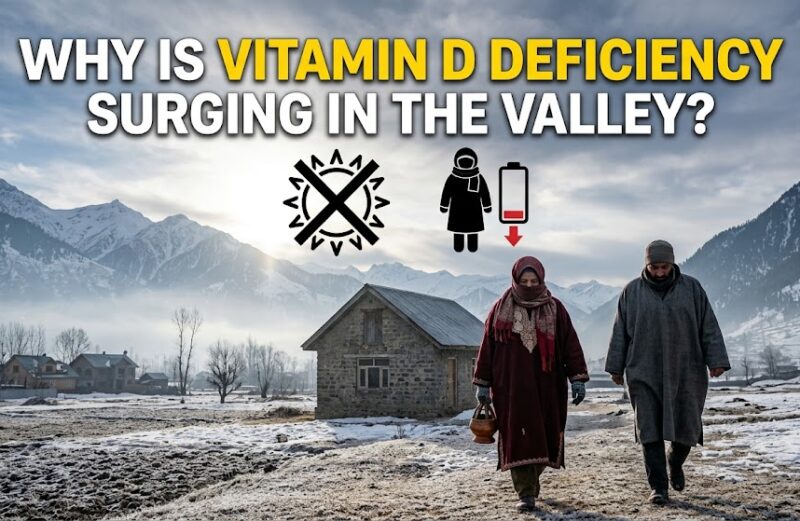
The geography of Kashmir is both its greatest blessing and, from a medical standpoint, its biggest challenge. Sitting at a latitude of 34°N, the valley experiences deep, fog-drenched winters where the sun becomes a rare luxury rather than a daily reality.
For generations, the people of Kashmir survived these winters through specialized architecture, thick clothing, and a culture built around staying indoors. But in doing so, we have inadvertently created a perfect storm for one of the most widespread, yet silent, health epidemics in the valley: Severe Vitamin D Deficiency.
Clinical studies from SKIMS and local diagnostic laboratories consistently paint a startling picture. Research published in the Indian Journal of Public Health Research and Development and previous landmark studies by Dr. A.H. Zargar reveal that up to 83% of healthy adults in Kashmir suffer from Vitamin D deficiency, with the numbers being particularly devastating for women.
This isn’t just a minor nutritional gap. It is a fundamental biochemical crisis affecting our bones, our immune systems, and even our mental health. Here is why the “Sunshine Vitamin” is vanishing from our bloodstreams, and what it means for the average Kashmiri.
The Geography and Physics of Kashmiri Sunlight
To understand why Kashmiris are so deficient, you first have to understand how Vitamin D is actually made. Unlike Vitamin C or Iron, which you primarily get from food, Vitamin D is actually a hormone synthesized by your skin.
When Ultraviolet B (UVB) rays from the sun hit your skin, they interact with a protein called 7-DHC, converting it into Vitamin D3. The liver and kidneys then process this into the active form of Vitamin D that your body can use.
But there is a catch: UVB rays cannot penetrate the atmosphere if the sun is at too low of an angle.
Because Kashmir is situated at 34 degrees North latitude, the zenith angle of the sun during winter (from November to March) is extremely low. Even if you were to stand outside on a rare sunny day in December, the UVB rays are largely filtered out by the Earth’s atmosphere before they ever reach the ground. The sunlight you feel might provide warmth, but it does not provide the specific wavelength required to trigger Vitamin D synthesis.
Add to this the thick winter fog, heavy cloud cover, and smog from bukhari (wood heater) smoke settling in the valley, and the UVB transmission drops essentially to zero for five months of the year.
The Cultural Barriers to Sunlight
Even during the summer months when UVB rays are strong enough, cultural and lifestyle factors in Kashmir prevent adequate synthesis.
1. The Pheran and Modesty
The traditional Kashmiri pheran is a masterclass in thermal insulation, designed to trap the heat of a kangri (fire pot) close to the body. However, Vitamin D synthesis requires direct skin exposure to the sun. The standard medical recommendation is exposing the face, arms, and legs for 15-30 minutes during midday.
In Kashmir, cultural norms of modesty, combined with the ubiquitous use of the pheran, mean that almost no skin is exposed to the sun. Even in summer, traditional clothing covers the majority of the body. Studies in the valley routinely show that women, particularly those who observe the hijab, have significantly lower levels of Vitamin D than men, often dropping below 12 ng/mL (severe deficiency).
2. The Indoor Shift
Historically, Kashmiris were an agrarian society. Farmers working in the fields or orchards all summer managed to build up “stores” of Vitamin D in their fat cells to last through the winter. (Vitamin D is fat-soluble, meaning your body can bank it for later use).
Today, our economy has shifted. We are a society of shopkeepers, government employees, and desk workers. We move from our homes, into our cars, and into our offices. The most recent data shows that the prevalence of deficiency is actually highest among the employed middle class and lowest among farmers, simply due to the nature of indoor work.
3. Dietary Limitations
Since we cannot get it from the sun, shouldn’t we get it from our food? Unfortunately, the traditional Kashmiri diet is incredibly poor in natural Vitamin D. The highest natural sources of Vitamin D are fatty fish (like wild salmon or mackerel), cod liver oil, and fortified dairy.
Our local fish (Gaad) are freshwater and do not contain high levels of Vitamin D. We consume large amounts of mutton and chicken, neither of which are significant sources. While we drink a lot of milk (mostly in Noon Chai), the milk supplied by local gujjars or standard dairy brands in the valley is rarely fortified with Vitamin D, unlike in Western countries where milk fortification is mandated by law.
The Silent Consequences: How Deficiency Feels
Most people in Kashmir walk around with Vitamin D levels below 20 ng/mL without realizing that their daily ailments are directly linked to this deficiency. It often masquerades as other issues:
The “Kashmiri Body Ache”: A very common complaint in the valley is diffuse bone pain, often dismissed as arthritis or “the cold getting into the bones.” In reality, severe Vitamin D deficiency causes a condition called osteomalacia in adults—a softening of the bones. Without Vitamin D, your body simply cannot absorb the calcium from your diet, no matter how much milk you drink.
Winter Depression (SAD): The deep lethargy, lack of motivation, and depressive moods many experience during Chillai Kalan are often linked to Seasonal Affective Disorder. Vitamin D receptors are found throughout the brain, and low levels are strongly correlated with mood disorders and chronic fatigue.
Immune System Failures: Vitamin D is crucial for activating the immune system’s T-cells (the “killer cells” that fight off infections). The constant cycle of winter colds, chest infections, and prolonged recoveries in the valley is exacerbated by the population’s suppressed immunity due to rock-bottom Vitamin D levels.
How to Combat the Epidemic
Fixing this isn’t as simple as just “going outside.” Because of our latitude, supplementation is not just recommended; it is medically necessary for survival in Kashmir.
1. Test, Don’t Guess
Never start taking high doses of Vitamin D without knowing your baseline. Vitamin D is fat-soluble, which means your body stores it. Taking too much over a long period can lead to Vitamin D toxicity (hypercalcemia), which damages the kidneys. You need a specific blood test called the 25-hydroxy Vitamin D test.
Deficient: < 20 ng/mL (Needs urgent medical correction)
Insufficient: 20-29 ng/mL (Needs mild supplementation)
Optimal: 30-50 ng/mL (The target range for healthy bones and immunity)
2. The Right Way to Supplement
If your doctor prescribes a supplement, usually a high-dose sachet (like 60,000 IU of Cholecalciferol/Vitamin D3) to be taken once a week for 8 weeks, you must take it correctly.
Take it with Fat: Because it is a fat-soluble vitamin, taking a Vitamin D pill with a glass of water on an empty stomach is almost useless. Your body won’t absorb it. You must take it with your heaviest, fattiest meal of the day—whether that is a bowl of mutton curry or a glass of full-fat milk.
The K2 Co-factor: When you take high doses of Vitamin D, your body absorbs a lot of calcium. But to ensure that calcium goes into your bones and doesn’t calcify in your arteries, you need Vitamin K2. Many modern supplements combine D3 and K2.
3. Sun Exposure When It Counts
From late April to September, the sun in Kashmir is strong enough for Vitamin D synthesis. During these months, try to expose your arms and face to the midday sun (between 11:00 AM and 2:00 PM) for just 15 to 20 minutes, a few times a week, before applying sunscreen.
A Public Health Priority
Vitamin D deficiency is an invisible crisis in the Kashmir valley. It is responsible for the epidemic of osteoporosis in our mothers, the chronic fatigue in our workforce, and the weakened immunity in our children.
We cannot change our geography, and we shouldn’t have to abandon our traditional pherans or cultural modesty. But we must modernize our approach to this fundamental hormone. A simple yearly blood test in November, followed by an inexpensive, targeted supplementation protocol, is all it takes to protect your bones, your mind, and your health through the long, dark Kashmiri winter.