Description
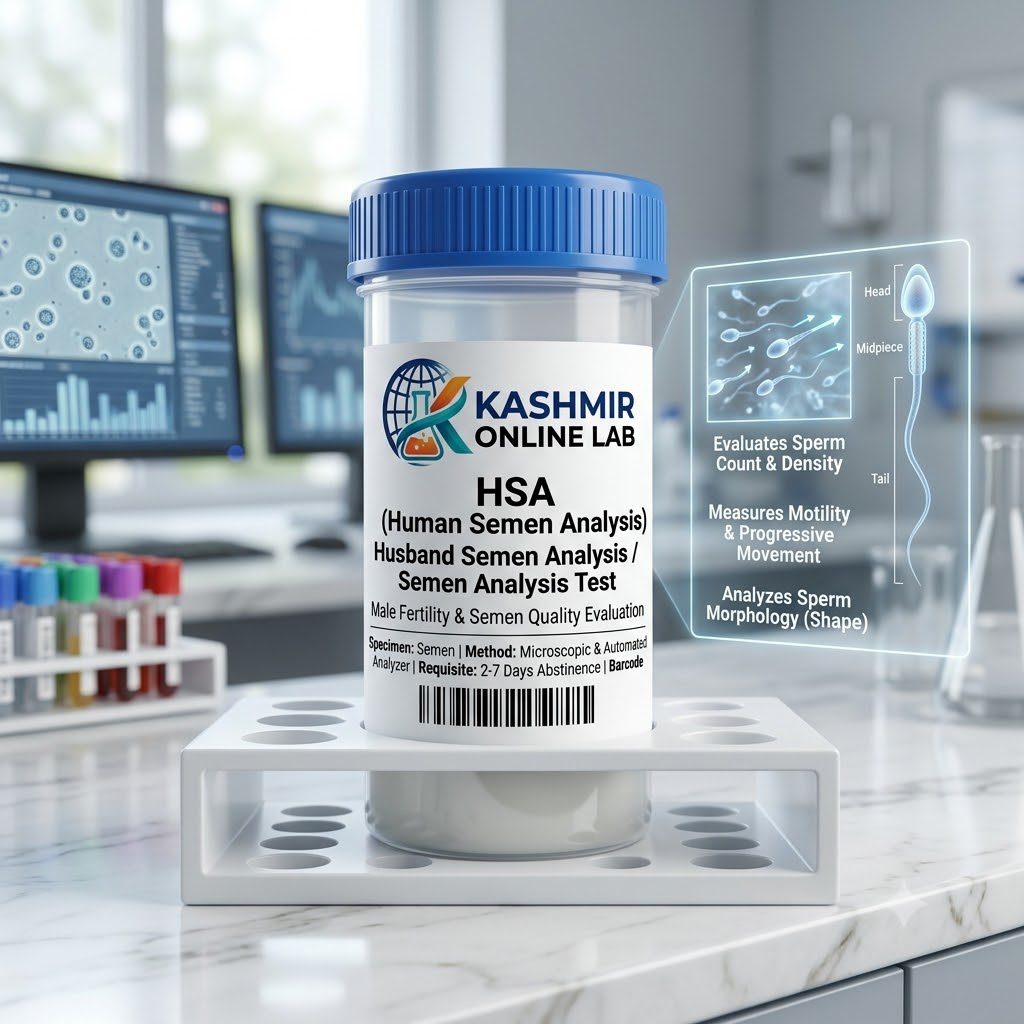
When couples experience difficulty conceiving, a thorough fertility workup is essential for both partners. Male factor issues contribute to approximately 50% of infertility cases, which is why the HSA (Human Semen Analysis) Test or Husband Semen Analysis is one of the first, most vital steps in a reproductive evaluation. “HSA” is a standard laboratory abbreviation often used interchangeably on clinical requisition slips for Semen Analysis, Sperm Count Test, or Seminogram.
This comprehensive test evaluates the microscopic and macroscopic characteristics of semen—the fluid containing sperm. By analyzing the physical properties of the fluid and the health, concentration, and behavior of the sperm, the HSA test provides clinicians with an accurate snapshot of a man’s reproductive health and potential.
Clinical Significance & Clinical Utility
Assessment of Male Fertility: The most common utility of the HSA test is the diagnostic evaluation of a couple’s difficulty conceiving. It determines if sperm-related issues (such as low count or poor movement) are factors in infertility.
Evaluation of Post-Vasectomy Success: It is used to verify the complete absence of sperm (azoospermia) a few months after a vasectomy, confirming the success of the surgical procedure before a couple can rely on it for birth control.
Diagnostic & Therapeutic Guidance: Identifying specific abnormalities—such as oligozoospermia (low count), asthenozoospermia (poor motility), or teratozoospermia (abnormal shape)—enables specialists (andrologists and reproductive endocrinologists) to choose appropriate fertility pathways (e.g., lifestyle changes, medications, IUI, or IVF/ICSI).
Identification of Underlying Medical Issues: Abnormal results can sometimes indicate hidden physical or biological conditions, such as varicocele, infections, hormonal imbalances, or genetic factors, guiding further medical investigation.
Test Interpretation
Laboratory evaluation follows the standardized reference ranges established by the World Health Organization (WHO) for human semen characteristics:
| Parameter | Normal Range (WHO 6th Edition) | Clinical Significance of Abnormal Values |
| Semen Volume | $\ge 1.4\text{ mL}$ | Low volume (Hypospermia) can suggest blockages, retrograde ejaculation, or hormonal imbalances. High volume can indicate inflammation. |
| Sperm Concentration | $\ge 16\text{ million/mL}$ | Low concentration (Oligozoospermia) significantly lowers the chances of natural conception. |
| Total Sperm Count | $\ge 39\text{ million per ejaculate}$ | Assesses the overall quantitative reproductive potential. |
| Total Motility | $\ge 42\%$ (Progressive $\ge 30\%$) | Assesses the percentage of active, moving sperm. Poor movement (Asthenozoospermia) prevents sperm from reaching the egg. |
| Morphology | $\ge 4\%$ normal forms | Evaluates sperm shape and structure. High percentages of abnormal shapes (Teratozoospermia) can affect the sperm’s ability to penetrate and fertilize an egg. |
| pH Level | $7.2\text{ to }8.0$ (Slightly alkaline) | Abnormally acidic or alkaline pH can indicate blockages or vesicle dysfunction and affect sperm survival. |
| Liquefaction Time | Within $15\text{ to }30\text{ minutes}$ | Delayed liquefaction (when semen remains gel-like) can impede sperm motility. |
| Vitality (Viability) | $\ge 54\%$ live sperm | Differentiates between live, non-moving sperm and dead sperm. |
| White Blood Cells (WBC) | $< 1.0\text{ million/mL}$ | Elevated levels (Leukocytospermia) typically indicate infection or inflammation of the reproductive tract. |
Test Requisites & Patient Preparation
To ensure precise and reliable results, patients must strictly adhere to the following preparatory guidelines:
Abstinence Period: The patient must observe 2 to 7 days of sexual abstinence (no ejaculation of any kind) before collecting the sample.
Shorter abstinence can result in an artificially low sperm count.
Longer abstinence can lead to higher numbers but significantly decreased sperm motility and viability.
Method of Collection: The sample must be collected entirely through masturbation directly into the sterile, wide-mouth container provided. Lubricants, saliva, or condoms must not be used, as they are toxic to sperm and will destroy the sample.
Temperature & Time Criticality: The sample must be kept at body temperature (ideally by holding the container close to the body/in a pocket) and delivered to the laboratory within 30 to 60 minutes of collection. Exposure to extreme cold or heat, or delays in processing beyond an hour, will kill the sperm and invalidate the test.
Labeling: Provide the container with complete patient details, tracking ID, exact time of collection, and the precise number of abstinence days.