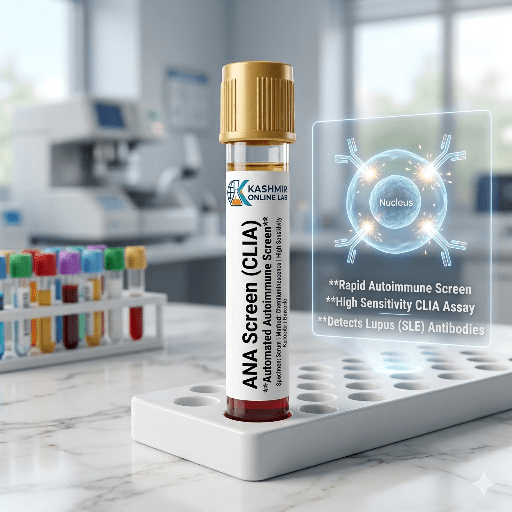
Description
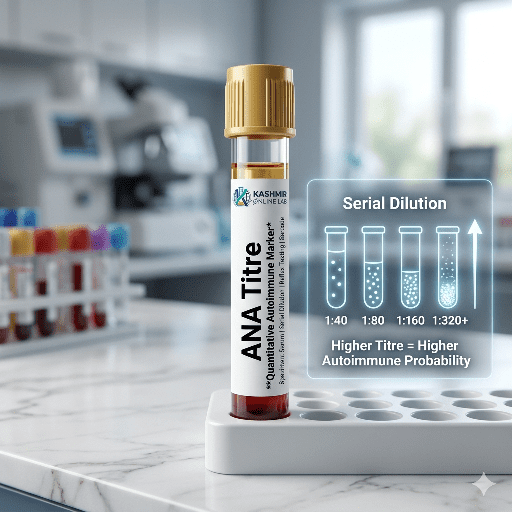
The ANA Screen by CLIA (Chemiluminescence Immunoassay) is a rapid, highly sensitive, and automated blood test used as a first-line screen for systemic autoimmune disorders, such as Systemic Lupus Erythematosus (SLE). It detects if the immune system is producing antibodies that mistakenly attack the nuclei of healthy cells.
Overview:
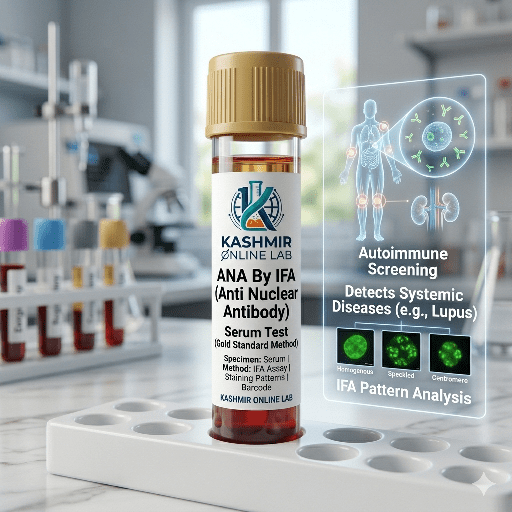
Antinuclear Antibodies (ANAs) are autoantibodies that target the center (nucleus) of the body’s own cells. While the IFA (Immunofluorescence Assay) method is the traditional gold standard for ANA testing, the CLIA method utilizes advanced, automated technology that uses light-emitting chemical reactions to detect these antibodies. CLIA is highly valued in modern laboratories for its objective, rapid, and highly sensitive screening capabilities, making it an excellent first step in autoimmune diagnostics.
Clinical Significance:
- Primary Autoimmune Screen: The ANA CLIA test is highly sensitive, meaning it is excellent at ruling out autoimmune diseases. A negative result strongly suggests that a systemic autoimmune condition is not the cause of the patient’s symptoms.
- Systemic Disease Detection: A positive result indicates the presence of autoantibodies and points toward conditions like Systemic Lupus Erythematosus (SLE), Sjogren’s Syndrome, Scleroderma, or Rheumatoid Arthritis.
- Objective Analysis: Unlike the IFA method, which requires a technician to manually interpret glowing patterns under a microscope, CLIA provides an automated, numerical (or semi-quantitative) value, reducing human subjectivity in the initial screening phase.
- Reflex Testing: If an ANA CLIA screen is positive, the laboratory or physician will typically follow up with an ANA IFA test to determine the specific staining pattern, or an ENA panel to identify the exact antibodies present.
When is this test recommended?
Healthcare providers typically order the ANA CLIA screen when a patient presents with vague, overlapping symptoms suggestive of an autoimmune condition, including:
- Chronic, unexplained joint pain, stiffness, or swelling.
- Severe, persistent fatigue and low-grade fevers.
- Unexplained skin rashes, particularly a “butterfly” rash across the cheeks and nose.
- Increased sensitivity to sunlight.
- Numbness or tingling in the hands and feet (Raynaud’s phenomenon).
Sample Requirements:
- Specimen: Blood (Serum).
- Container: A standard Gold-top Serum Separator Tube (SST) or a plain Red-top tube.
Patient Preparation:
- General: No specific fasting is required for this test. Patients can maintain their normal diet and hydration.
- Medication Review: Certain medications (like those used for blood pressure or seizures) can cause a “drug-induced” positive ANA. Patients should ensure their physician has a complete list of their current medications.