Description
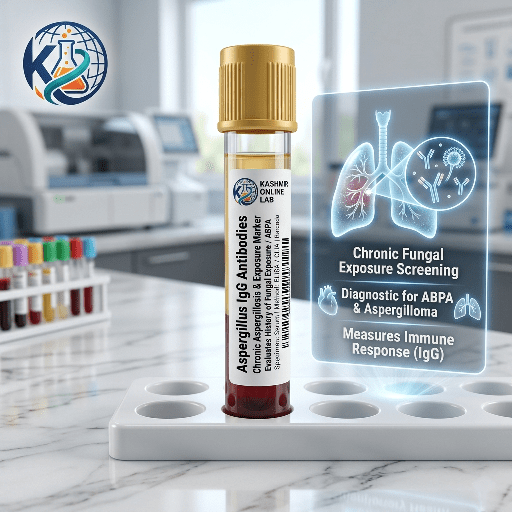
The Aspergillus IgG test measures the concentration of Immunoglobulin G antibodies specific to the Aspergillus fungus in a blood serum sample. Since IgG antibodies typically represent a long-term or chronic immune response, this test is primarily used as a marker for prior exposure, chronic forms of aspergillosis (like a chronic pulmonary aspergilloma or ‘fungal ball’), or sensitization in conditions such as Allergic Bronchopulmonary Aspergillosis (ABPA).
Clinical Utility and Applications:
- Chronic Pulmonary Aspergillosis (CPA) Marker: The most significant detailed application of the quantitative Aspergillus IgG assay is its pivotal role in the diagnosis of CPA. A major criterion for CPA—including chronic cavitary pulmonary aspergillosis (CCPA) and chronic fibrosing pulmonary aspergillosis (CFPA)—is the presence of significant anti-Aspergillus antibodies. Quantitative results allow clinicians to differentiate true disease from common environmental background exposure and, importantly, to monitor treatment response over time, as IgG levels should decrease with effective antifungal therapy.
- Aspergilloma Confirmation: While a radiological finding (e.g., a pulmonary cavity containing a ‘fungal ball’) is the primary detection method for an aspergilloma, a high Aspergillus IgG test confirms the fungal etiology. It demonstrates that the immune system has responded to the established Aspergillus colony, distinguishing a true aspergilloma from other non-fungal cavitary lesions.
- Allergic Bronchopulmonary Aspergillosis (ABPA): In patients with asthma or cystic fibrosis, elevated Aspergillus IgG is a key supportive diagnostic criterion for ABPA (specifically ABPA-S or seropositive ABPA), working in conjunction with high total and specific IgE levels to confirm fungal sensitization and subsequent immune complications.
- Differentiating Fungal Exposure History: It helps rule out acute, invasive aspergillosis (where other tests like Galactomannan are more sensitive) and provides crucial context when interpreting pulmonary nodules or cavities of unknown origin, indicating a semi-chronic or chronic fungal process rather than just passive, low-level environmental sensitization.
- Environmental Exposure and Sensitization: The test can semi-quantitatively assess history of high-level or sustained environmental Aspergillus exposure (e.g., occupational exposure, agricultural mold inhalation), providing data for both clinical management and public health assessments.
Test Interpretation:
- Significantly Elevated Results: Highly suggestive of chronic forms of aspergillosis (CPA or aspergilloma) or significant ABPA complications, necessitating further diagnostic imaging (CT, Bronchoscopy) and clinical correlation.
- Moderately Elevated/Low Positive Results: May represent historical exposure, low-level chronic sensitization, or an asymptomatic environmental background commonly found in the general population. Clinical context and correlation with other markers are critical.
- Negative/Below Cutoff Results: Makes chronic aspergillosis very unlikely and suggests no current semi-chronic fungal response or sensitization is present.