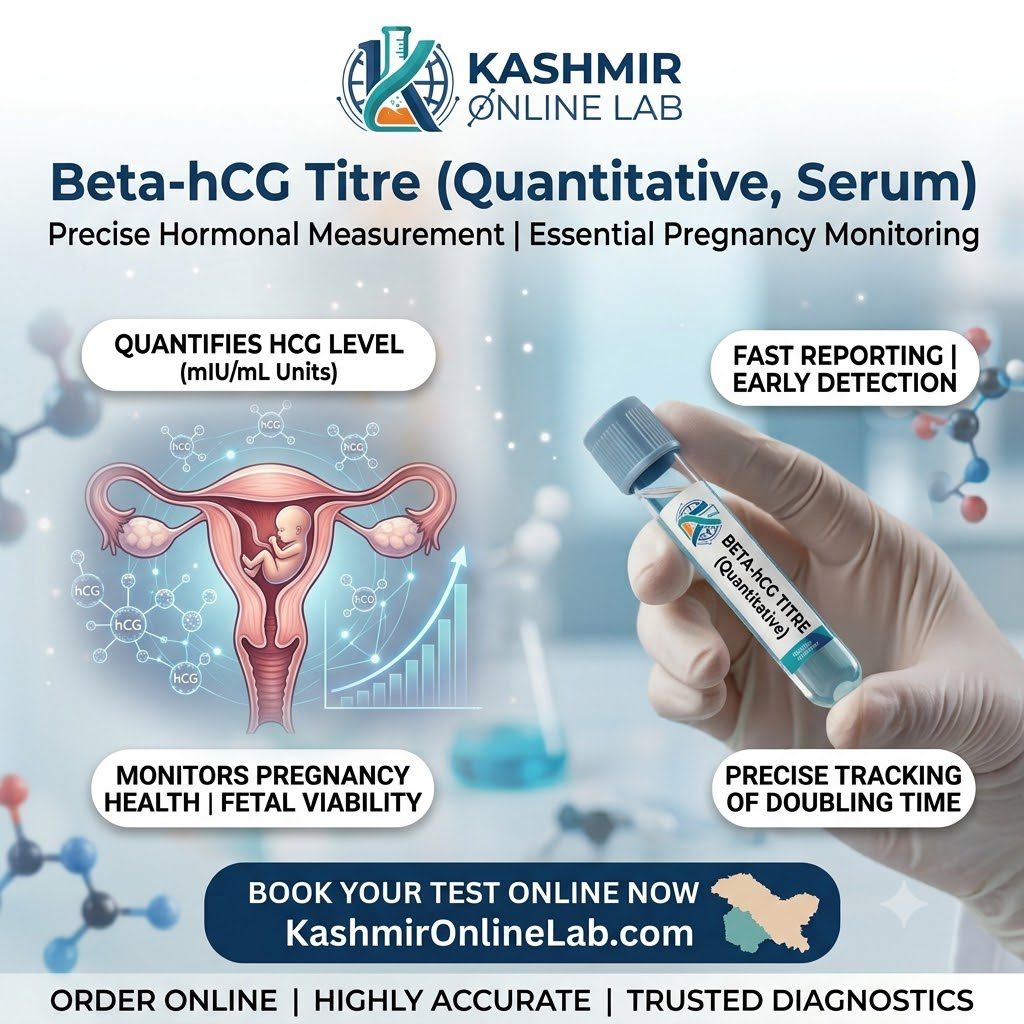
Description
The Beta-hCG Titre (Serum) is a high-precision quantitative blood test that measures the exact level of Human Chorionic Gonadotropin hormone in your bloodstream. This test is essential for confirming early pregnancy, monitoring fetal health, assessing ectopic or high-risk pregnancies, and evaluating gestational trophoblastic conditions. Fast, accurate, and reliable reports delivered directly to you.
What is the Beta-hCG Titre Test?
Human Chorionic Gonadotropin (hCG) is a hormone produced primarily by the placenta shortly after a fertilized egg attaches to the uterine lining. Unlike standard urine home pregnancy tests that only provide a simple positive or negative result, a Beta-hCG Titre (Quantitative) blood test measures the exact concentration of the hCG hormone in milli-international units per milliliter (mIU/mL).
In a normal early pregnancy, Beta-hCG levels typically double every 48 to 72 hours. Tracking these levels through serial testing provides invaluable clinical insights into the viability and progression of the pregnancy.
Why is This Test Ordered?
Your gynecologist, obstetrician, or physician may recommend this test for several clinical reasons:
Early Pregnancy Confirmation: Detecting pregnancy as early as 8–11 days after conception, long before a missed period.
Monitoring High-Risk Pregnancies: Evaluating pregnancies with a history of miscarriage, bleeding, or spotting.
Assessing Ectopic Pregnancy: Identifying pregnancies developing outside the uterus (where hCG levels rise at a significantly slower rate than normal).
Evaluating Trophoblastic Disease: Diagnosing and monitoring conditions such as molar pregnancies or gestational trophoblastic disease (GTD).
Fertility & IVF Monitoring: Tracking hCG levels closely following assisted reproductive treatments like embryo transfer or IUI.
Tumor Marker Evaluation: In rare cases, Beta-hCG serves as a diagnostic marker for certain testicular or ovarian germ cell tumors.
Test Specifications & Patient Guidelines
| Parameter | Specification |
| Sample Type | Blood (Serum) – 3 mL in Serum Separator Tube (SST) or Red Top |
| Preparation / Fasting | No fasting required. Can be taken at any time of the day. Inform your doctor about any fertility medications containing hCG. |
| Methodology | Chemiluminescence Immunoassay (CLIA) / Electrochemiluminescence (ECLIA) |
| Recommended For | Pregnancy confirmation, maternal health monitoring, fertility tracking, and oncology evaluation |
| Report Turnaround Time | Same Day / Within 24 Hours (Rapid clinical processing) |
| Home Sample Collection | Available across Srinagar and major districts via Kashmir Online Lab |
nterpretive Reference Ranges for Beta-hCG (Quantitative, Serum)
Important Clinical Note: Gestational age is calculated from the first day of the patient’s Last Menstrual Period (LMP), not from the date of conception. Reference ranges may vary slightly depending on the specific analytical method and reagent kit used in the laboratory.
| Gestational Age / Patient Status | Expected Beta-hCG Range (mIU/mL) |
| Non-Pregnant Females | < 5.0 mIU/mL (Negative) |
| Borderline / Indeterminate | 5.0 – 25.0 mIU/mL (Repeat test recommended in 48 hours) |
| 3 Weeks (from LMP) | 5 – 50 mIU/mL |
| 4 Weeks (from LMP) | 5 – 426 mIU/mL |
| 5 Weeks (from LMP) | 18 – 7,340 mIU/mL |
| 6 Weeks (from LMP) | 1,080 – 56,500 mIU/mL |
| 7 to 8 Weeks (from LMP) | 7,650 – 229,000 mIU/mL |
| 9 to 12 Weeks (Peak Level) | 25,700 – 288,000 mIU/mL |
| 13 to 16 Weeks (2nd Trimester) | 13,300 – 254,000 mIU/mL |
| 17 to 24 Weeks | 4,060 – 165,400 mIU/mL |
| 25 to 40 Weeks (3rd Trimester) | 3,640 – 117,000 mIU/mL |
| Postmenopausal Females | < 9.5 mIU/mL |
| Adult Males | < 2.0 mIU/mL |
How to Understand Your Beta-hCG Titre Results
The Importance of Serial Testing: A single blood draw rarely tells the whole story in early pregnancy. In a normal, healthy intra-uterine pregnancy, Beta-hCG levels typically double every 48 to 72 hours during the first 4 to 8 weeks. Your doctor will often order two consecutive tests spaced 48 hours apart to evaluate the doubling time and rate of increase.
What Could Higher-Than-Expected Levels Indicate?
Miscalculated LMP: The pregnancy may simply be further along than initially estimated.
Multiple Gestation: Carrying twins, triplets, or multiples often produces significantly higher hCG concentrations.
Trophoblastic Disease: Extremely elevated levels can occasionally point to a molar pregnancy or gestational trophoblastic condition.
What Could Lower-Than-Expected Levels Indicate?
Miscalculated LMP: The conception may have occurred later in the ovulation cycle than calculated.
Ectopic Pregnancy: When a fertilized egg implants outside the main uterine cavity (such as in a fallopian tube), hCG levels usually rise at a much slower, abnormal rate.
Risk of Miscarriage: Levels that plateau, fall prematurely, or fail to double appropriately may signal a non-viable or failing pregnancy.