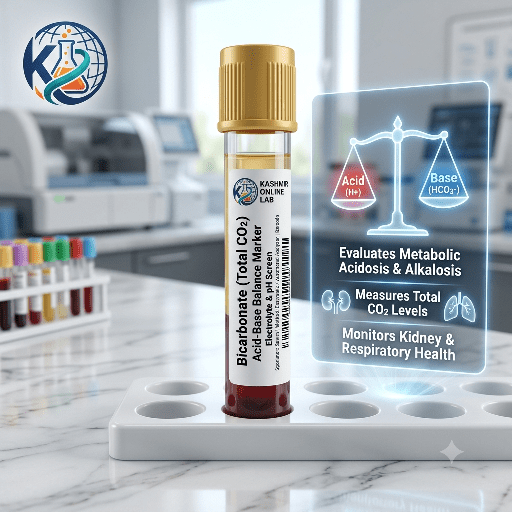
Description
The Bicarbonate – Serum test (often measured as Total CO2) is a fundamental blood test used to evaluate the body’s acid-base balance (pH) and overall electrolyte status. It is a critical marker for detecting and monitoring conditions that affect the blood’s acidity, including kidney disease, respiratory disorders, and severe metabolic imbalances like metabolic acidosis or alkalosis.
Overview:
Bicarbonate is a vital electrolyte and a primary component of the body’s buffering system. Its main job is to keep the acid-base balance (pH) of the blood within a tight, healthy range (around 7.35 to 7.45). The regulation of bicarbonate is a collaborative effort between the lungs (which exhale carbon dioxide) and the kidneys (which excrete or reabsorb bicarbonate).
In a standard clinical laboratory setting, a serum bicarbonate test actually measures the total amount of carbon dioxide (tCO2) in the liquid part of the blood, because bicarbonate accounts for roughly 95% of this total CO2.
Clinical Significance:
- Evaluates Acid-Base Imbalances: This is the primary test for identifying metabolic acidosis (abnormally low bicarbonate, making the blood too acidic) or metabolic alkalosis (abnormally high bicarbonate, making the blood too basic).
- Assesses Kidney Function: Because the kidneys are responsible for regulating bicarbonate levels, abnormal results often point to renal dysfunction, such as acute kidney injury or chronic kidney disease.
- Monitors Respiratory Conditions: Patients with chronic lung diseases (like COPD or severe asthma) often have altered bicarbonate levels as the kidneys attempt to compensate for the lungs’ inability to properly clear carbon dioxide.
- Calculates the Anion Gap: Bicarbonate is almost always measured alongside sodium, potassium, and chloride as part of an Electrolyte Panel or Comprehensive Metabolic Panel (CMP). Together, these values calculate the “anion gap,” which helps physicians pinpoint the exact underlying cause of an acid-base disorder.
When is this test recommended?
Healthcare providers typically order a Serum Bicarbonate test:
- As part of a routine health screening (within a basic or comprehensive metabolic panel).
- When a patient presents with symptoms of an acid-base imbalance, such as prolonged vomiting or diarrhea, confusion, extreme fatigue, or respiratory distress.
- To monitor patients with known chronic conditions like kidney disease, hypertension, or chronic lung disorders.
- In emergency settings to evaluate critically ill patients or those with severe dehydration.
Sample Requirements:
- Specimen: Blood (Serum).
- Container: A standard Gold-top Serum Separator Tube (SST) or a plain Red-top tube.
Patient Preparation:
- General: No special preparation or fasting is required if the bicarbonate test is ordered on its own. However, if it is ordered as part of a broader Comprehensive Metabolic Panel (CMP), the patient may be required to fast for 8 to 12 hours prior to the blood draw.