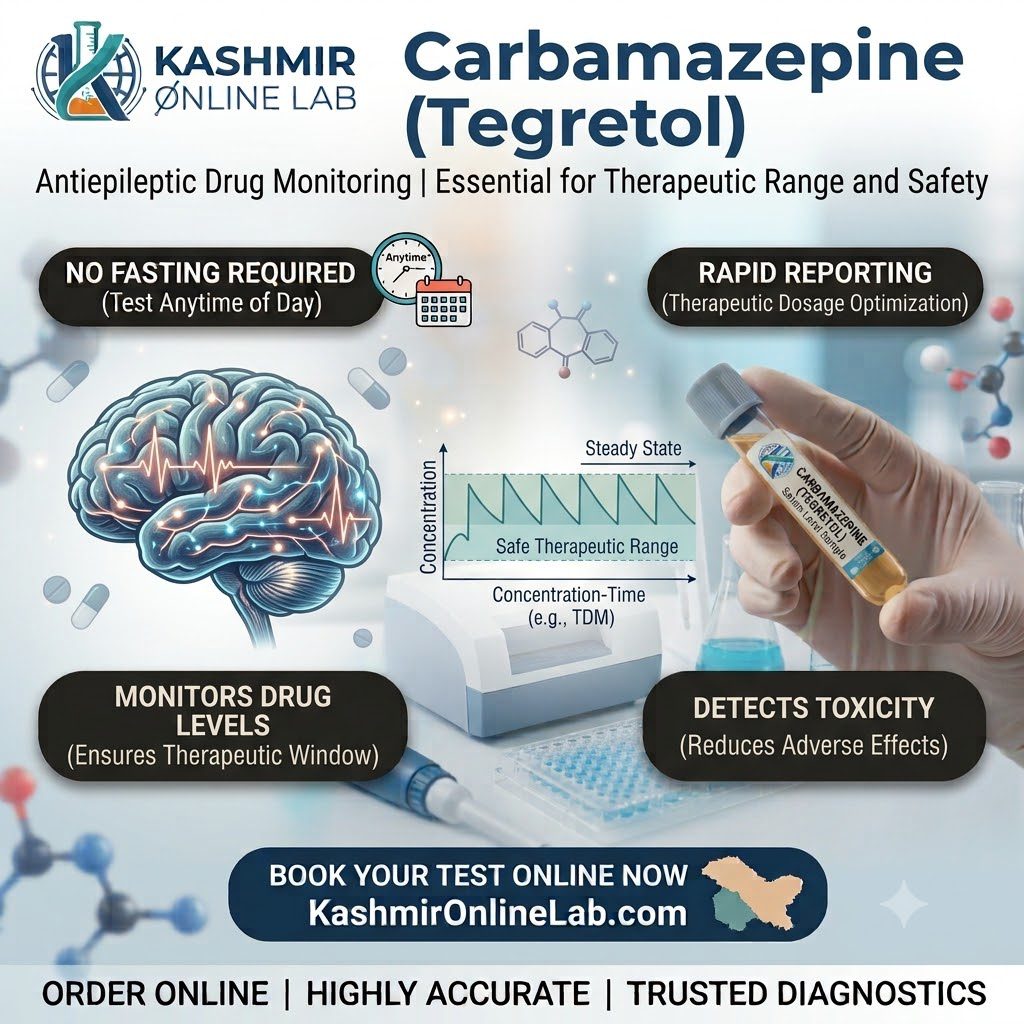
Description
Overview:
Carbamazepine (Tegretol) Level, Serum (sold under brand names like Tegretol or Zeptol) is a widely used medication for treating epilepsy (seizures), trigeminal neuralgia (nerve pain), and bipolar disorder. Because the body processes this drug at variable rates, and because it has a “narrow therapeutic index” (the difference between a helpful dose and a toxic dose is small), regular monitoring is critical.
Clinical Significance:
Therapeutic Drug Monitoring (TDM): The goal is to keep blood levels between 4 and 12 mcg/mL.
Preventing Toxicity: Levels that are too high can cause dizziness, unsteadiness, double vision, and confusion.
Ensuring Efficacy: Levels that are too low may result in the recurrence of seizures or nerve pain.
Drug Interactions: Carbamazepine interacts with many other medications, which can suddenly alter its concentration in your blood.
When is this test recommended?
Routine Monitoring: Regularly to ensure the dosage remains correct over time.
Suspected Toxicity: If symptoms like nausea, dizziness, or blurred vision occur.
Lack of Control: If seizures return despite taking the medication.
New Medications: When starting or stopping other drugs that might interfere with Carbamazepine.
Sample Requirements:
Specimen: Serum.
Container: Red Top (Plain) Tube is preferred. Note: Gel tubes (SST) are sometimes avoided for drug levels as the gel can absorb the drug, lowering the result. Check specific lab protocol.
Timing (Trough Level): The sample should ideally be drawn just before your next scheduled dose (trough level) to measure the lowest concentration in the blood.
Why is This Test Ordered?
Your doctor or neurologist may recommend regular testing for several important reasons:
Dosage Optimization: Finding the correct daily dosage when starting or adjusting carbamazepine therapy.
Preventing Seizure Breakthroughs: Investigating why seizures or nerve pain may have returned despite consistent medication use.
Screening for Toxicity: Evaluating unexplained symptoms of overdose, such as chronic dizziness, double vision, drowsiness, ataxia (unsteady gait), confusion, or nausea.
Assessing Drug Interactions: Monitoring levels when starting or stopping other medications that can alter how the liver processes carbamazepine.
Verifying Compliance: Ensuring consistent intake of the prescribed regimen.
Test Specifications & Patient Guidelines
| Parameter | Specification |
| Sample Type | Serum (Plain Red-Top Tube Only) – Minimum 2 mL venous blood. |
| Important Lab Note | Do NOT use SST / Gel Separator Tubes. The gel barrier in standard SST tubes can absorb carbamazepine, leading to falsely low readings. |
| Collection Timing (Trough Level) | Blood must be drawn immediately before your next scheduled dose (usually 15 to 30 minutes prior) to measure the lowest steady-state drug level. |
| Fasting Requirement | No dietary fasting required. You may eat and drink normally prior to your blood draw. |
| Methodology | Homogeneous Microparticle Immunoassay (KIMS) / Chemiluminescence |
| Report Turnaround Time | Same Day / Within 24 Hours (Rapid clinical processing) |
| Home Sample Collection | Available across Srinagar and major districts via Kashmir Online Lab |
Part 2: Interpretive Reference Ranges & Clinical Guidance
Include this reference guide on your product page to help patients and referring doctors interpret their laboratory reports.
| Clinical Window | Serum Concentration (µg/mL or mcg/mL) | Clinical Interpretation |
| Sub-Therapeutic | < 4.0 µg/mL | Increased risk of seizure breakthrough or inadequate pain relief. |
| Optimal Therapeutic Range | 4.0 – 12.0 µg/mL | Optimal clinical response for most adults and children. (Single drug regimen: 8–12 µg/mL; Multi-drug: 4–8 µg/mL). |
| Elevated / Warning Window | 12.1 – 14.9 µg/mL | Dose reduction may be required; patient should be monitored for mild side effects. |
| Toxic / Critical Level | ≥ 15.0 µg/mL | High risk of neurological and cardiovascular toxicity. Immediate medical evaluation required. |